
Colonizing the US
What if the population was more evenly distributed?

“All we know are the facts ma’am”
- Jack Webb as Sgt. Joe Friday on the 1950’s TV Drama, “Dragnet”
The Facts
There are 3,143 counties and county equivalents (e.g. parishes in Louisiana, boroughs in Alaska, and the District of Columbia) in the United States. According to 2017 Census Bureau statistics, more than 50% of the U.S. population is found in 4.6% (143) of these counties. Considering that the land area of the Lower 48 states is nearly 3 million square miles (not counting the water area), in theory, a more even distribution of the population over the expanse of the nation is possible. Of course, the amount of land is not the sole determinant; factors like climate and terrain, and economic considerations also figure into why people cluster in particular areas.
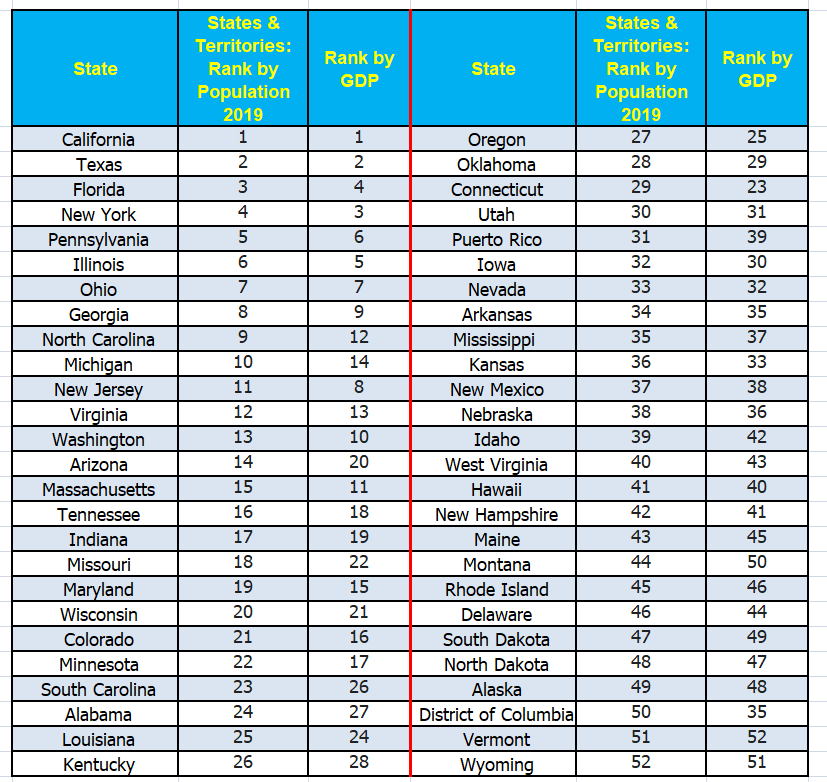
As you can see from the table below, the population of states and territories correlates closely to the size of their economies: for the most part, the more populated the state, the larger the economy. Unlike climate and terrain, we do have a considered effect on the economy of a specific location.
The Hypothesis
What if the population of the US was more evenly distributed, more widely dispersed? Would there be positive effects if we did not crowd ourselves into urban and suburban areas and leave large swaths of the nation sparsely inhabited? What economic, political, and cultural advantages would be obtained if we incentivized the growth of mid-sized cities, micropolitan areas? Would we be able to shed pejorative terms such as “coastal elites” and “fly-over country”? Would internal migration lead to a greater sense of national unity?
Thoughts
Given that the US economy is increasingly knowledge-driven, and that, as our adaptation to the pandemic illustrates, more and more work is performed remotely, workers need not be in or near an urban center to do their jobs. In a 2018 report from Brookings, authors Nathan Arnosti and Amy Liu made the point that cities are important to rural economies, but “a network of nearby cities could be better for rural America than a few big “superstar” cities”.
Micropolitan areas like Traverse City, Mich., Corning, N.Y., and Kalispell, Mont. could serve as stronger centers of jobs, finance, and opportunities for rural households. Rather than sprinkle limited resources across every rural county, state and federal policymakers could target efforts to small and mid-sized markets by helping them strengthen commercial corridors and modernize existing industries.
Encouraging this type of internal migration does not necessarily mean turning acres of farmland into sprawling subdivisions. It could instead lead to the resuscitation of what journalist James Fallows calls ” underdog cities—communities and regions that are aware of losing out and having been overlooked. Some are in Appalachia, some in the Deep South, some around the Great Lakes, some in inland regions of otherwise-prospering states in the West.”
Writing in The Atlantic earlier this year, Fallows reported on the efforts of a private company, Bitwise Industries, to “expand opportunities for tech-related jobs in under-served communities”. Bitwise’s mission is “to support the actions needed to stop the widening wealth gap, end institutional discrimination, and remove the barriers for accessing high-wage, high-growth jobs.” It works to achieve what it calls a “Digital New Deal” through the creation of technology training centers, incubators for startup businesses, partnerships with schools and universities, and in some cases physical renovations of run-down buildings. Its funding comes from a variety of private investors.
Having been successful in several California cities beginning with Fresno, the company is embarking on an ambitious effort in the Great Lakes region, beginning with Toledo, Ohio. It’s raised $50 million from investors such as Kapor Capital, JPMorgan Chase, Motley Fool Ventures, and Toledo’s largest employer, healthcare non-profit ProMedica. Its approach will be based on the model developed in California- partnerships among city and state governments, universities, community groups and NGOs, and companies large and small, with a local focus. Bitwise intends Toledo to be the first in a series of projects for underdog cities in the Midwest and elsewhere.
Of course, economic development requires human capital as well as a financial investment. The historic trend for decades has been people moving from the Northeast and Upper Midwest to the Sun Belt. This is especially true of retirees. But the result has been to simply relocate populations from one urban center to another, from New York City to Metro Atlanta, or from Southern California to Arizona. It is too soon to measure the effects of the pandemic but it may provide the impetus for people to move to less populated areas. Fear of infection in crowded cities, less expensive housing in smaller communities, and the increasingly routine use of remote employees may be compelling reasons to relocate. With many of the needs of daily life being handled via online resources, we no longer need to be near a bank, for example. (The Biden Administration has recognized the importance of broadband access and made its widespread availability a priority in its infrastructure proposal.)
Colonizing America
The United States is experiencing a period of binary divisiveness: Whether it be rural versus urban or red state versus blue state, regional divisions have eroded our sense of national unity. Factors such as the loss of manufacturing jobs in regions such as the upper Midwest are often cited as the source of political and social frustration. Cynical politicians seem bent on fanning the flames of discontent. Relocating significant numbers of people to micropolitan regions would have an ameliorating effect in those places. Simply building the requisite infrastructure would provide economic stimulus in the form of jobs and investment. Projects such as the Bitwise undertaking in Toledo are an example of a training and incubator initiative designed for a 21st Century economy.
Besides economics, such a population dispersal might resurrect the myth of the nation as a melting pot. More of the country would be exposed to the diversity that is commonly found in the large coastal cities. The cross-pollination of cultures and language would extend into heretofore homogeneous communities. Realizing that the demographic trend is for whites to become a minority in the country by mid-century, diverse groups migrating into less populated states would influence the political balance in those states. Given the current condition of the Republican Party, not even their voter suppression approach will endure as their control of state governments is inevitably put in jeopardy.
The people who colonized this continent changed it. Generations of immigrants brought more dramatic change. Moving some of our current population into the less-populated states will bring about even more change. It is essentially another form of colonization.
Note: Please leave your comments in the Comment section by clicking on the button. Replying to the email of this newsletter means your comments can not be seen and responded to by other readers.
Reminder to readers: Each Wednesday evening 168 opens a weekly discussion thread that I begin by posting a question to which you all may post replies, respond to each other, and explore the topic. The only condition is that you stick to the main topic. If you have suggested topics, please email me at nicrosato2@gmail.com.
The 168 newsletter is emailed each weekend and at other times on an unscheduled basis. Newsletters are also posted to www.1hundredsixty8.substack.com. Visit the site to view archived newsletters.
Certain content is restricted to paying subscribers only.
Please consider becoming a paying subscriber for $5.00 per month.
Aside from your comments- which are encouraged- if you would like to submit a piece of your own for 168, please email me at nicrosato2@gmail.com.
My past blog posts from 2013-2020 are viewable at 1hundredsixty8.com.